
Faneng: Unterschied zwischen den Versionen
Aus EnzyklopAtys
K |
K |
||
| Zeile 1: | Zeile 1: | ||
| − | + | [[File:Rubber-Stamp-Lore choix Vert.png|64px|left|link=Category:To be check]][[Category:To be check]]{{Trad | |
|DE=Faneng | |DE=Faneng | ||
|DEs=1 | |DEs=1 | ||
| Zeile 5: | Zeile 5: | ||
|ENs=4 | |ENs=4 | ||
|ES=Faneng | |ES=Faneng | ||
| − | |ESs= | + | |ESs=4 |
|FR=Faneng | |FR=Faneng | ||
|FRs=0 | |FRs=0 | ||
| Zeile 20: | Zeile 20: | ||
|aggro=Nein | |aggro=Nein | ||
|damage=}} | |damage=}} | ||
| − | + | Plant of singular appearance, which could be taken for a mushroom, the '''faneng''' is in fact the fleshy shoot of a large rhizome. | |
| + | |||
| + | This toxic, very stringy bud bears at its apex a green puff called cladode which is used for photosynthesis. Only this upper part is used by [[Zoraï|Zoraïs]] (the faneng-hakka<span id=Lang><sup>[[#Lang|*]]</sup></span>, which they think is a host plant) who extract from it a particularly effective anti-toxin. | ||
| + | |||
| + | <noinclude>[[File:Faneng-Face.png|thumb|center|300px|Faneng head]]</noinclude> | ||
| − | |||
| − | |||
{{Clear}} | {{Clear}} | ||
---- | ---- | ||
| − | <small>< | + | <small>[[#Lang|*↑]] <span id=Lang>The “faneng host” in [[Taki Zoraï]].</span></small> |
| − | ---- | + | ----{{Last version link|Faneng}}<noinclude>{{Portal|Flora}} |
| − | {{ | + | {{TIP|DE=1|EN=4|ES=4|FR=0|RU=}} |
| − | {{Portal|Flora}} | ||
[[Kategorie:Flora]] | [[Kategorie:Flora]] | ||
[[Kategorie:Wurzeln]] | [[Kategorie:Wurzeln]] | ||
| − | [[Kategorie:Flora des Dschungels]] | + | [[Kategorie:Arzneipflanzen]] |
| + | [[Kategorie:Toxische Pflanzen]] | ||
| + | [[Kategorie:Flora des Dschungels]]</noinclude> | ||
Version vom 14. November 2019, 18:40 Uhr

 •
•
 •
•
 •
•
 •
•
 •
•

| Taxonomie-Bernstein | |
| Faneng im Winter | |
|---|---|

| |
| Reich | Pflanzen |
| Gruppe | {{{species}}} |
| Ökosystem | Dschungel |
| Aggressiv | Nein |
| Art des Gegenangriffs | Wehrlos |
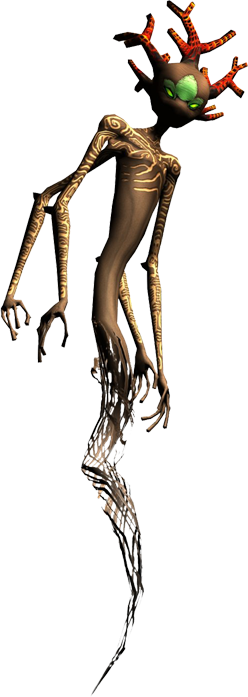
Plant of singular appearance, which could be taken for a mushroom, the faneng is in fact the fleshy shoot of a large rhizome.
This toxic, very stringy bud bears at its apex a green puff called cladode which is used for photosynthesis. Only this upper part is used by Zoraïs (the faneng-hakka*, which they think is a host plant) who extract from it a particularly effective anti-toxin.

*↑ The “faneng host” in Taki Zoraï.
Neueste Version 22.11.2021•ᐒ

 Übersetzungs Status → Dies ist eine von 32 Seiten, die wir gerne ins Deutsche übersetzt sehen würden. Übersetzungs Status → Dies ist eine von 32 Seiten, die wir gerne ins Deutsche übersetzt sehen würden.
|
 Übersetzung angefordert • Übersetzung angefordert •  Translated • Translated •  Traducido • Traducido •  Original • Original •  Не переведено Не переведено
|